Showing posts with label tutorial. Show all posts

Aug 19, 2014

Makeup Brush Roll Tutorial

I got a special reuqest from a friend recently to make her a makeup brush roll. Like so many of us, she does her makeup on the go, but wanted a good way to carry around all of her brushes. I was more than happy to whip up this simple project.

Here is how you can make your own makeup brush roll. This is a pretty easy project, and would be great for a beginning sewer--only straight lines here.


First here is what you will need for this project:
1 9" x 15" piece of fabric
1 9" x 15" piece of interfacing (optional)
1 9" x 15" piece of lining fabric
1 10" x 15" piece of fabric for the pocket
18"-20" piece of ribbon or bias tape 
Sewing machine (can also be hand sewn)
Scissors
Thread
(The fabric can be different sizes to work for whatever you need.)


Take the pocket piece, fold it in half lengthwise, and iron it. Then top stitch the pocket along the fold line. Pin the pocket to the lining fabric, and sew along the sides and bottom of both pieces. Use a scant 1/8" seam (this will insure that this line of sewing will be hidden once it is finished).


Now it's time to mark your pockets. You can customize these pockets to what ever size you need. I made a few 1 1/2" pockets, and then varied the sizes (from 3/4" to 1") to be able to accommodate a variety of brush sizes. I marked them with a pencil to be able to see it on my fabric.


Sew the pocket markings from the bottom to the top. This will ensure that you don't have any bubbles or puckering at the bottom of the pockets. Remember to back stitch at the top to reinforce those pockets.

Next take your ribbon or bias, fold it in half and sew along one side of your lining/pocket piece. Sew it so the tie lies on the inside of the fabric.


Now with the right sides together, place the exterior fabric on top of your lining/pocket piece. Sew along the sides and bottom of the roll.  Then sew along the top, leaving an opening for turning.


Turn out the pouch and iron it. Iron in the seam allowance for the opening. This will make it easier to top stitch. Now, top stitch (stitch very close to the outer edge of the pouch), starting at one of the sides. When you get to the opening, top stitch which will close the roll completely.


Now it's all ready to tote your favorite makeup brushes. I like to keep my liners and mascaras in the roll too.


You can also adapt this to make a crayon or pencil roll, perfect for back-to-school.

Jan 28, 2014

Quick baby blanket

There seems to be a baby boom around me, and that means making baby gifts for me. There are so many things that are so cute to make for little ones. I made a blanket like this one for my niece when she was a baby, and she still loves it now that she's 2. This little blanket is also perfect for the stroller or car seat, plus the minky fabric is so soft against the baby's skin.


This quick baby blanket is easy and comes together in no time. You need only a few simple supplies:
  • 3/4 yard of fabric
  • 3/4 yard contrasting minky fabric (you can also use flannel or anything soft)
  • double fold bias binding (one package or enough to cover the edge of your blanket)
  • thread
  • sewing machine
My blanket is a rough measurement, but it's about 27 inches by 24 inches. Cut one of the fabrics to the measurement then lay that fabric on top of the second fabric and cut them to the same size. Pin around both fabrics to make this easier.


Take both fabrics, and while they were still pinned together, serge around the edges. If you don't have a serger, you can just zig-zag around the edges. Now, remove all of the pins.


Next, take the bias binding and wrap it around the edge of the blanket.  Sew the binding around the serged edge. (If you have trouble making the corners square and neat, just round the corners and the bias binding will curve around it.)


And voila! That's all there is to it. You have a great easy blanket that is a perfect baby gift.


With some basic sewing knowledge, this project shouldn't take more than about an hour. And the result is so cute, who wouldn't want one.

Have you ever made any baby gifts?

Dec 12, 2013

Handmade holidays: Etched glass candle holder

I thought I'd give you some ideas in the next few weeks to make some great handmade gifts. Handmade gifts can really get you into the holiday spirit, but don't have to take long to make. This  project is inexpensive and quick, but looks like it costs way more.

All you need is a glass candle holder (I got mine at the dollar tree), a paintbrush, tape or stickers (to make your design and Armour Etch (<-- affliate link). This is an etching cream that will "etch" your glass in just a few minutes.
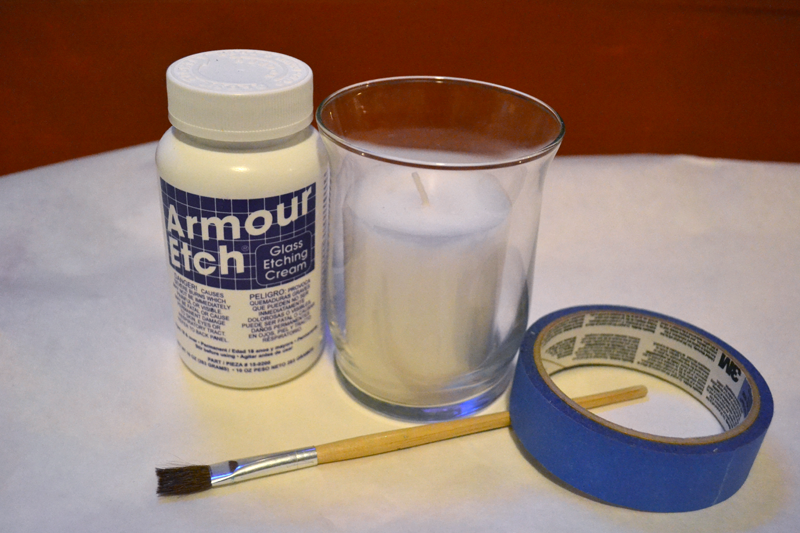

I got my glass candleholder at the Dollar Tree. You can find the best things there for only $1!


The first step is to tape up your design.  You have to remember that the etching will happen anywhere that is not covered by tape. Make sure the edges of your tape are really pushed down, so the etching liquid doesn't seep underneath (Note: I didn't do a good job of this!).
 
 
Then paint on the Armour Etch. I apply it really heavy to make sure that the etchin really takes hold of the glass. Then just leave on the etching medium for about 5 minutes.


After that, take it to your sink and rinse off the Armour Etch.


Peel of your tape and/or stickers, and voila... etched glass!


It really makes a plain candle holder have a little more design to it. This is a great easy project that you can whip up in no time once you have the supplies on hand.


This is just the first of my handmade holiday posts, check back next week to get another great handmade holiday idea.

Oct 30, 2013

Glitter shoes tutorial

A great accessory for any costume are some glitter shoes. They can make a fairy or princess even more perfect, and can just add that special touch to a normal outfit. I made some glitter shoes for my Halloween costume this year.

I had some old thrifted shoes that were perfect to glitter up for my costume. Glittering shoes (or glittering really anything) is so easy.

Here are the supplies you'll need:
  • Mod Podge
  • Glitter
  • Sandpaper
  • Paintbrush
  • Newspaper

  • Pour some Mod Podge into a container (I use a disposable bowl for ease of cleanup) and then add the glitter right to the Mod Podge. This is the key to this technique. Since you mix the Mod Podge with the glitter, it seals the glitter in place, making way less of a mess.

    Next you'll need to prep your shoes. All they need is a light sanding with some fine grit sandpaper. You just want to take the shine off of the shoes, so the glitter will stick even better.


    Stuff the inside of your shoes with newspaper to make sure the inside stays clean. Take your paintbrush and paint on the Mod Podge/glitter mixture. It might take a couple of coats to get the color you want. Just paint a coat on and let it dry a bit before adding more. It will look white, but the Mod Podge will dry clear and you will be able to see the glitter really sparkle.

    Then wait for them to dry. After you have done all of your coats, let them dry overnight, so they will be really dry before you wear them.

    Once they are dry it's like you have a whole new pair of shoes.

    And voila! Your very own glitter shoes. You can use any color of glitter and any shoes you want to get the look that would be perfect for you.

    Any guesses on my Halloween costume this year?

    Oct 16, 2013

    Minnie costumes with circle skirt tutorial

    Since I did a RunDisney race, I needed to make a costume. That's just part of the fun of doing a race at Disney. For my first RunDisney race, Kristina and I kept it simple and decided to go as Minnie Mouse, a classic.


    It was a simple costume, black t-shirts, Minnie skirts and ears. We had the black tees, that was the easy part. Then we got the red and white polka dotted fabric to make the skirts. I decided to make half circle skirts. These would give us enough room to move while we ran, but wouldn't be to bulky. And I wanted to have elastic waistbands for ease of movement and getting them on and off. The hardest part was making the patterns. It involves math! Eww! But it's not that hard, if I can do it anyone can.

    You just need two measurements, waist measurement and the length of your skirt.

    Here are my measurements (so you can see how it works):
    Waist: 29 inches
    Length: 13 inches

    I'm gonna get math-y on you now... Your waist measurement is the circumference. In order to get the radius of the circle to be able to make your pattern you need to divide your waist measurment by 2 x 3.14 (π). But I'll make it even easier for you. Take your waist measurement and add two inches for seams. Then divide by 6.28. My equation looked like this:  31 ÷ 6.28 = 4.93 (I rounded up to 5)


    The answer to your equation is the radius of your skirt to make a full circle skirt. Since I was making a half circle skirt, I doubled this number to 10. I then pulled out my pattern paper and marked 10 inches from the corner of the paper. You could use a compass to make the circle, but seriously who has one that big? So just mark your 10 inches (or whatever your measurement is on various spots all starting at the corner, then just connect the dots.


    After you have the waist marked, measure from your waist line down to your length. I measured 13 inches down and made the same markings. Then I played connect the dots and cut out my pattern. This pattern will be very wide, so if you have standard 44 inch wide cotton, like I did, you will have to open it up to be able to get your whole pieces cut out.


    I cut out two of these pieces and serged all of the edges. I sewed up the sides seams, and then it was time to attach the waistband. The waistband was just a piece of 3 inch elastic cut to my waist measurement plus 1 inch. I sewed the edges of the elastic together to create a tube. Next, I had to attach the skirt to the elastic waist. I pinned the skirt to the elastic at the front, back and sides. The skirt was a bit bigger than the elastic, which you need to be able to get into the skirt. All you have to do is stretch the elastic as you sew and this should give it the stretch it needs.


    After you've attached the skirt to the waistband, just sew a small hem. Your skirt is ready to go. (Don't forget to try it on to make sure it fits right.)


    Next was time to make the ears. And luckily I found a great tutorial on Bombshell Bling for Minnie ears. Instead of using hot glue, I sewed the ears and used heavy Peltex 70 interfacing for the interior. Our bows were made of the same fabric as the skirts and it was all attached to dollar store headbands. I didn't know if the ears would make it through the race, but they lasted all day long.


    This costume was pretty easy once you have the skirt pattern made. Don't let it intimidate you, just measure it out start cutting. This would make a great Halloween costume too. It's super comfy, so it's great for a night full of trick or treating.


    P.S. I might have a made a mini verison of this for my niece too!

    I love making these running costumes. And since I have a few more RunDisney races in my future, and there will be plenty more race costumes coming.

    Have you ever made a costume?

    Jul 22, 2013

    Car litter bag tutorial

    About a month ago, I got a new car. I'm loving it, except that I didn't have a little garbage bag in it.  I had made one for my other car, so I figured this one needed one as well. Thankfully it's a super quick project. Here are all the details, so you can make your own.

    Here is what you will need:
    1 exterior fabric piece 18" by 13"
    1 lining fabric piece 18" by 13"
    8-10" elastic (depending on the length you need)
    Thread
    Sewing machine
    Scissors

    I used that reusable grocery tote fabric for my exterior, which is pretty sturdy. For the interior, I think it's best to use a heavy cotton duck. This way there will be no need to use interfacing. If you are using a lighter fabric, just use some Craft Fuse interfacing and fuse to your panels before proceeding.

    Make a small hem on the top of the long side of both panels, then fold in half right sides together and sew down the short side. The top and bottom should be open. The panels should be like tubes.

    Stack both the exterior and lining tubes on top of each other matching the seams. Then sew across the bottom of both tubes together. They will be joined at the bottom now by the bottom seam but will still be 2 separate tubes.

    Flip the exterior fabric right side out. The lining fabric will be on the inside of the exterior fabric.

    It should look like this, with your lining inside of your exterior, with the tops still loose.

    Then add a piece of elastic as your handle. I line mine up with the seam on the side, so I can hang my bag off of the shifter in my car.

    Voila! There you have your own car litter bag. Just use plastic grocery bags or even better, doggie bags as your bag liner. Just tuck the end in between the exterior and lining to keep your garbage bag in place.

    This is a great little project that will really make your life so much easier when you're driving around.

    Do you have a garbage bag in your car?

    Jul 8, 2013

    Gym bag redo

    The bag I had been using to go to the gym (which was just a reusable tote bag) broke last week. I decided I should make myself a cute new gym bag that incorporated all the features I really wanted. I've been designing my heart away and adding so many little details that it's turning into a slightly bigger project than I anticipated. But I needed a new bag to go to the gym on Monday, so I grabbed one of the many drawstring bags that I have collected over time and made it a little cuter.

    I grabbed my basic drawstring bag and some scraps of fabric and a little interfacing and got to work. I measured the logo (8 inches by 2 inches) and made it a little bigger so I could make sure it would all be covered. I also made it taller to be able to use it as a pocket. My final fabric size was 8 1/2" by 6 1/2". I cut two out of the fabric and one of interfacing, to give the pocket some body. 

    I ironed the interfacing to one of the pocket pieces and then placed them wrong sides together. I sewed around one long side and both short sides using 1/4" seams. On the other long side, I also sewed with a 1/4" seam, but left a small part open, so I could turn the pocket right side out. I clipped the corners, turned the pocket right side out and ironed it flat. Then I topstitched the top edge of the pocket. I pinned the pocket in place to make sure it stayed centered and then sewed down the sides and bottom, leaving the top part open. Make sure you are only sewing on one side of the bag and not both, or you will sew your bag shut!

    This was a little too plain, so I decided I needed to cover the top part of bag, where the drawstrings are. The drawstring pockets were about 1 inch wide, so I knew I had to make them a little wider to make sure the drawstring would still work. I cut 3 inch strips for each of the sides of the bag. I made them a little wider than the bag itself (I eyeballed it), so I could fold in each side to keep the seams clean. After sewing in the short sides, I ironed in a 1/4" seam allowance on each of the long sides.


    I then folded these strips in half leaving one side slightly longer than the other (like in bias binding). I sandwiched the strips around the edge of the bag, and sewed them around the existing drawstring pockets on the bag.

    There was one strip for each side of the bag and it really gave it the finishing touch it needed.

    And voila! I took an old junky bag and gave it a makeover. And now I can show up to the gym without having a half broken bag.

    I'm still working on my huge gym bag, and I hope to be able to start working on that one soon. I'll keep you updated on that one.

    Have you ever revamped an old item to make an even better one?